“You can save a life — but at what personal cost?”
Modern medicine is full of awe-inspiring breakthroughs. But behind every high-stakes intervention — whether in transplant surgery, intensive care, emergency medicine, or paediatrics — are the clinicians making impossible choices in impossible circumstances.
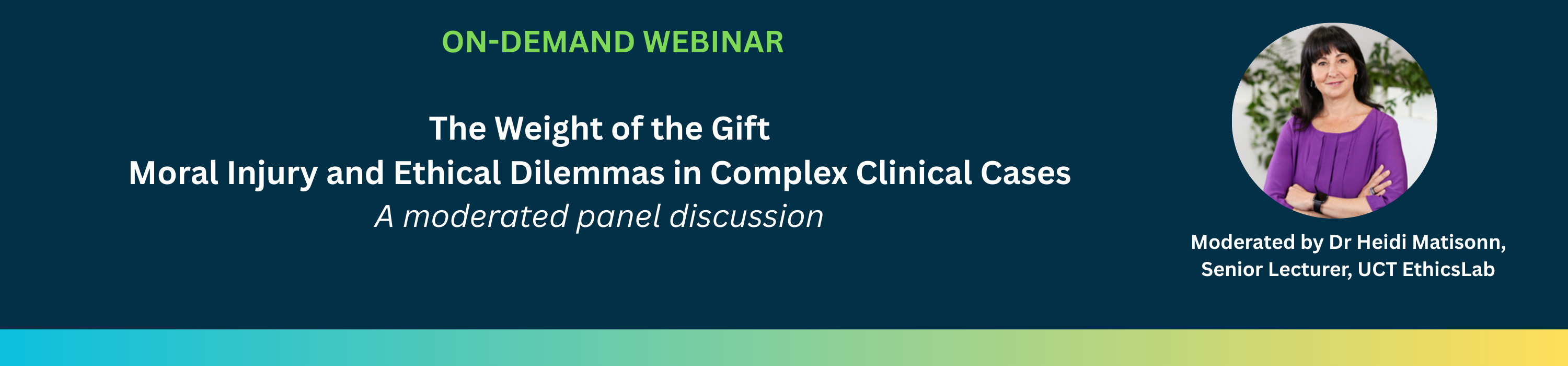
In this emotionally resonant and panel-driven session, Dr Heidi Matisonn, Senior Lecturer in Bioethics at the UCT EthicsLab, moderates a dynamic and honest discussion with leading voices across specialities.
Together, they explore moral injury: the deep psychological and ethical dissonance experienced when clinicians feel compelled to act in ways that violate their personal or professional code.
It’s not burnout. It’s not fatigue. It’s something more insidious — the quiet erosion of moral clarity in systems marked by scarcity, inequity, and complexity.
Through real-world stories and case reflections, this innovative forum unpacks the ethical tensions at the heart of modern healthcare — from transplant decisions and ICU triage to systemic failures, fractured communication, and what it means to carry moral responsibility: to make impossible choices under pressure, to act within flawed systems, and to live with the emotional aftermath of decisions that save some lives while letting others go.
What You Will Learn
We speak with leading voices in surgery, ethics, paediatrics, intensive care, and psychosocial care to uncover:
The ethical grey zones:
• How do clinicians reconcile choosing one patient over another when both need life-saving intervention?
• What does it mean to uphold “first, not harm” in situations where every option carries significant risk or uncertain outcomes?
Systemic limitations, personal toll:
• What happens when you know the ethically right course of action — but the system won’t allow it?
• How do under-resourced public hospitals and structural inequities shape clinical decisions, and who carries that weight?
The unspoken emotional labour:
• From ICU nurses and paediatricians to transplant coordinators and trauma surgeons — who supports the supporters?
• Why are moral injuries so often buried beneath professional stoicism and institutional silence?
Healing and resilience: • Can we create open, protected spaces for clinicians to speak honestly about moral distress — without stigma or fear?
• What role do mentorship, peer debriefing, and ethics consultations play in helping healthcare teams process harm and rebuild moral clarity?
Senior Lecturer in Bioethics in the EthicsLab, University of Cape Town
+
Your Panelists
Professor David Thomson
Consultant Transplant and Critical Care Surgeon at University of Cape Town, Groote Schuur Hospital
+
Dr Tinus du Toit
Head of Abdominal Transplantation, Groote Schuur Hospital
+
Professor Zunaid Barday
Nephrologist, Groote Schuur Hospital
+
Dr Marisa Beretta
Paediatric Hepatologist at Wits University Donald Gordon Medical Centre
+
Your Host
Linda Ravenhill
Editor, Medical Education Network
+
Dr Marsia Baretta
Dr Marisa Beretta is a Consultant in Paediatric Hepatology at the University of the Witwatersrand's Donald Gordon Medical Centre, home to South Africa’s largest paediatric liver transplant unit. She completed her MBChB, MMed, and subspecialty training at Wits, becoming a Fellow of the College of Paediatricians in 2014 and sub-specialising in 2018.
An Honorary Lecturer in Paediatrics since 2022, Dr Beretta is actively involved in national transplant and hepatology networks. She serves on the SATS Liver Working Group and is a member of the 29th South African Transplant Society Congress Committee.
Her research includes acute liver failure and contributions to multi-centre reports on paediatric liver transplantation, including as a contributor to the ground-breaking GALA Study (2023).
As part of the specialist team at Wits Donald Gordon Medical Centre, Dr Beretta contributes to the latest advancements in paediatric liver care for children from across South Africa. She is a passionate advocate for increasing awareness of paediatric liver disease and expanding equitable access to transplantation. Her goal is to represent South Africa on the international stage and help shape the future of paediatric liver transplant medicine.
Professor David Thomson
Professor David Thomson is a Critical Care specialist and a consultant surgeon in the Transplant Unit at Groote Schuur Hospital. He is a lecturer at the University of Cape Town.
David completed his undergraduate medical training in Durban at the University of KwaZulu Natal. He went on to specialize in surgery at the University of Cape Town completing his FCS in 2011, MMed in surgery in 2012 and a critical care fellowship in 2015. He was the winner of the Bunny Angorn prize in Surgical Research and was awarded the Garron Caine Travelling fellowship spending time in Boston, USA at Massachusetts General Hospital, Brigham and Women’s Hospital and the Harvard Centre for Surgery and Public Health.
He works between the Critical Care Department and the Transplant Unit performing kidney and liver transplants and ICU rounds. He has an interest in promoting organ donation and transplantation. Specifically through education projects and by refining hospital systems to ensure all potential donors are adequately assessed and managed and that the families are appropriately counselled.
Dr Tinus Du Toit
Dr. Tinus Du Toit serves as Head of Abdominal Transplantation at Groote Schuur Hospital and holds a key academic appointment in the Department of Surgery at the University of Cape Town. He trained at Stellenbosch (MBChB) and completed advanced surgical qualifications at UCT.
With rich clinical experience—including over 400 kidney and 100 liver transplants—Dr. Du Toit is deeply committed to the science and humanity of organ transplantation. His research contributions span innovative donation models—such as successful multi-organ retrieval from district hospitals without ICUs—and pioneering the first documentation of African kidney transplants using donors after circulatory death.
Professor Zunaid Barday
Professor Zunaid Barday is a consultant nephrologist at Groote Schuur Hospital in Cape Town, South Africa. He earned his medical degree at the University of Cape Town, completing his specialist training in internal medicine in 2001, followed by nephrology training at the same institution.
Since qualifying as a nephrologist in 2006, he has led the hospital’s Transplant Clinic alongside transplant surgeons, including Professor Del Kahn and Dr Elmi Muller. Working within the resource-constrained state healthcare sector, Dr Barday has developed extensive expertise in applying cost-effective approaches to renal transplantation.
Dr Marsia Baretta
Dr Marisa Beretta is a Consultant in Paediatric Hepatology at the University of the Witwatersrand's Donald Gordon Medical Centre, home to South Africa’s largest paediatric liver transplant unit. She completed her MBChB, MMed, and subspecialty training at Wits, becoming a Fellow of the College of Paediatricians in 2014 and sub-specialising in 2018.
An Honorary Lecturer in Paediatrics since 2022, Dr Beretta is actively involved in national transplant and hepatology networks. She serves on the SATS Liver Working Group and is a member of the 29th South African Transplant Society Congress Committee.
Her research includes acute liver failure and contributions to multi-centre reports on paediatric liver transplantation, including as a contributor to the ground-breaking GALA Study (2023).
As part of the specialist team at Wits Donald Gordon Medical Centre, Dr Beretta contributes to the latest advancements in paediatric liver care for children from across South Africa. She is a passionate advocate for increasing awareness of paediatric liver disease and expanding equitable access to transplantation. Her goal is to represent South Africa on the international stage and help shape the future of paediatric liver transplant medicine.
Dr Heidi Matisonn
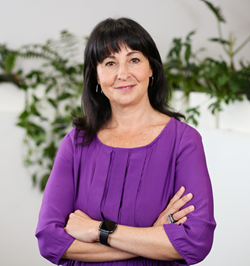
Trained as a moral and political philosopher, Heidi is employed as a Senior Lecturer in Bioethics in the EthicsLab based in the Neuroscience Institute at the University of Cape Town, South Africa. The central theme of Heidi’s work is to think and enact care in the context of the academy.
As a philosopher, this means conceptualising and understanding ‘care’ as an essential component of what makes us human. As an academic teacher, this means thinking deeply about how to structure a bioethics curriculum so that students have optimal opportunities for learning and development whilst also being supported to make sense of the ethics of our world.
As a bioethicist, it means advocating for the integration of perspectives from care ethics into how we think about and address ethical challenges. It also means working alongside healthcare providers to understand the importance of care in addressing moral distress.
Linda Ravenhill
Linda Ravenhill is the Founder and Editor of the Medical Education Network. With over three decades of healthcare experience, she qualified in Intensive Care and Trauma Nursing at Charlotte Maxeke Johannesburg Academic Hospital, holds a qualification in International Marketing Management (IMM), and earned an MA in Journalism from the University of the Witwatersrand, where her research focused on medical narratives surrounding end-of-life care in the elderly.
She worked in clinical publishing with the South African Medical Association before founding her technology and digital publishing company in 1999.
Her work has been widely recognised for its innovation and impact at the intersection of digital healthcare and medical communication. She was a finalist in the 2011 Cartier Women’s Initiative, served as a Ford Global Ambassador, and was a social entrepreneurial candidate for the Wavelength Foundation. In 2016, she was recognised at the Reuters EyeforPharma awards for her contribution to healthcare for the creation of the South African Rare Diseases education platform in conjunction with Sanofi.
Passionate about good clinical science, narrative medicine, and ethics — and how they intersect to improve the quality of care in sub-Saharan Africa — Linda is committed to making complex medical research accessible, relevant, and ethically grounded.
The Medical Education Network is an independent, free-for-use resource for healthcare practitioners in sub-Saharan Africa.
We provide a range of quality clinical information sourced from peer-reviewed journals and original articles to facilitate continued medical education and knowledge sharing.
If you would like to be involved with our programs or contribute to our site, please contact us
Our Policies
Your information and the quality of our content are important to us.
Our policies are listed below. If you have any concerns, please contact us